Cart
0
What a balancing cleansing emulsion actually is
If you've ever stepped out of the shower and felt that familiar tightness across your cheeks — the squeak, the sting when toner hits — your cleanser is the first thing I'd look at. Most of the reactive-skin cases that walk into the clinic don't need a new serum. They need to stop stripping their barrier twice a day.
A balancing cleansing emulsion is a gel-to-milk texture that uses milder surfactants — usually coco-glucosides or amino-acid derivatives — instead of sulfates. It lifts off makeup, SPF and sebum without pushing your skin's pH into alkaline territory. That's the whole pitch. No foam theatre, no squeak, no rebound oil at 3pm.
How it differs from a traditional foam
Traditional foaming cleansers love sodium lauryl sulfate. It cleans beautifully — and it also dissolves a chunk of your stratum corneum lipids on the way out. Emulsions sidestep that. The oil phase grabs lipid-soluble grime (sebum, sunscreen filters, mascara), the water phase rinses everything clean, and your ceramides stay put.
You'll feel the difference inside a week. Skin that used to feel "clean" after washing — meaning bone-dry — starts to feel comfortable instead.
Why reactive skin reacts in the first place
Sensitised skin isn't quite the same as genetically sensitive skin. It's acquired. Something — usually a cleanser, an over-zealous acid routine, or relentless sun — has thinned the barrier enough that everything else starts to sting too. Survey data from the European Academy of Dermatology and Venereology puts self-reported sensitive skin at around 60% of European adults, which says less about genetics and more about how most of us wash our faces.
The barrier itself is a brick-and-mortar setup: corneocytes held together by ceramides, cholesterol and free fatty acids. Strip the mortar and water escapes (the technical term is transepidermal water loss), irritants walk in, and you're suddenly reacting to a moisturiser you've used for two years.
What erodes it
In my experience, the four big culprits are predictable. High-pH soap-based cleansers. Over-exfoliation — yes, that includes the daily glycolic toner. Sun exposure without consistent SPF, which matters more in southern Europe than anywhere else. And the friction of hot water plus a rough towel.
The pH point most people miss
Healthy skin sits around pH 4.5–5.5. Bar soap and high-foaming gels typically clock in at 8–10. Korpan and colleagues, writing in the International Journal of Cosmetic Science, showed that even short exposure to alkaline cleansers measurably disturbs barrier recovery for hours afterwards. A pH-matched emulsion sidesteps the problem entirely.
What an emulsion does for sensitive skin
It cleanses. That's the job. The reason it earns shelf space over a foam is what it doesn't do — it doesn't dehydrate, it doesn't sting, and it doesn't leave skin in the alkaline window where irritants get a free pass.
Most clients I see with persistent redness around the nose and cheeks improve noticeably within two to three weeks of switching, with nothing else changed in their routine. No new serum, no new moisturiser. Just a gentler cleanser, used correctly.
Ingredients worth looking for
The good ones pair mild surfactants with humectants and soothers — sodium hyaluronate, panthenol, allantoin, beta-glucan. The format also lets formulators include trace lipids that replace what cleansing inevitably removes. That's the difference between a cleanser that respects the barrier and one that just doesn't actively destroy it.
A simple routine built around it
Sensitive skin doesn't need a ten-step routine. It needs a short one, executed consistently. Here's what I recommend in the clinic.
Morning
- Rinse only, or a half-pump of emulsion. Lukewarm water, never hot. If your skin felt clean overnight, water alone is fine.
- Hydrating mist or alcohol-free toner. Pressed in, not wiped.
- Lightweight moisturiser. Look for ceramides, panthenol, squalane.
- Broad-spectrum SPF 30–50. Mineral filters (zinc oxide, titanium dioxide) tend to suit reactive skin best. Non-negotiable in Iberian or Mediterranean sun, even in winter.
Evening
- First cleanse if you've worn SPF or makeup — an oil or balm to break it down.
- Second cleanse with the balancing emulsion. A dime-size dollop on damp skin, 30 to 60 seconds of gentle circles, rinse with lukewarm water, pat dry with a clean towel.
- Hydrating or soothing serum. Hyaluronic acid, niacinamide at 2–5%, or panthenol.
- Moisturiser — slightly richer than your morning one if your skin tolerates it.
Patch-test any new product on the inner forearm or behind the ear for 48 hours before putting it on a reactive face. I know, it's tedious. Do it anyway.
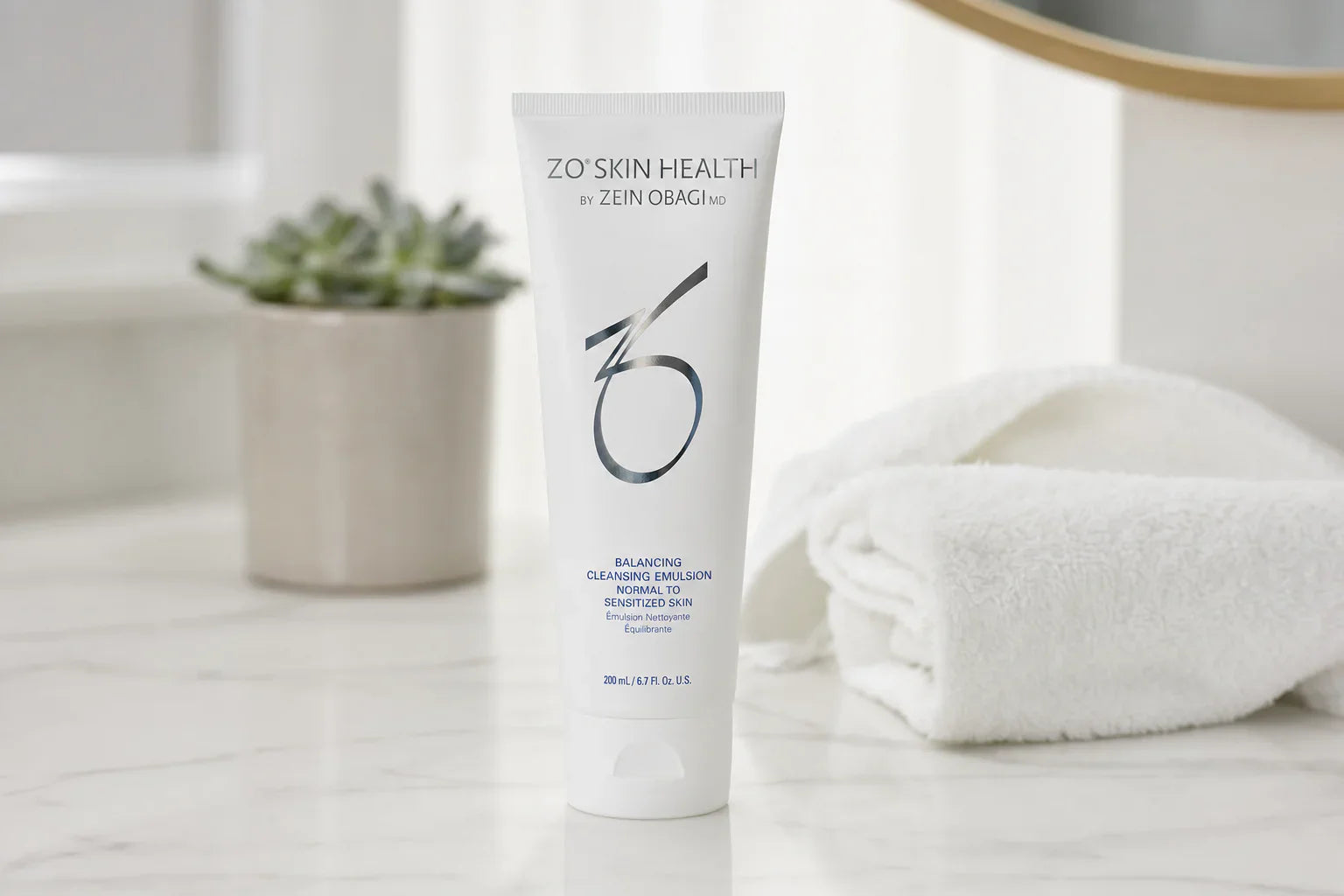
The hero: ZO Skin Health Balancing Cleansing Emulsion
Among the formulations I've worked with on reactive skin, ZO Skin Health Balancing Cleansing Emulsion is the one I keep coming back to. Developed by Dr. Zein Obagi, it's built around a gel-to-milk system with sodium hyaluronate, panthenol and allantoin doing the soothing work in the background. No sulfates, no added fragrance, no dyes — which removes three of the most common irritation triggers in a single stroke.
It rinses cleanly. That sounds obvious until you've used a creamy cleanser that leaves a film, then chased it with toner-soaked cotton trying to feel "really clean." This one doesn't do that. Skin feels comfortable, not stripped, not coated.
Is it more expensive than a drugstore foam? Yes. Will you use less of it per wash, and stop spending money chasing barrier-repair serums to undo the damage from the cheap option? Also yes — that's been my experience, anyway.
Frequently asked questions
How is a balancing cleansing emulsion different from a regular cleanser?
Texture and surfactant choice. Foam cleansers rely on sulfates that create big lather and clean aggressively. Emulsions use gentler cleansing agents that transform from gel into a milky rinse-off, removing the same grime without pushing your skin's pH alkaline. For barrier-compromised skin, that pH detail matters more than any single hero ingredient.
Can I use it daily on sensitive skin?
Yes. It's designed for twice-daily use. If your skin is in an actively flared state, you can drop to once a day (evening only) and rinse with water in the morning until things calm down.
Does it remove sunscreen?
Most non-waterproof SPF, yes — in one go. Water-resistant mineral SPF or full makeup needs a first cleanse with an oil or balm, then the emulsion as the second pass. Don't try to scrub a stubborn SPF off with a single cleanser; that's how irritation starts.
How do I know I need to switch?
Tightness after washing. Stinging when serum goes on. New redness around the nose or cheeks. Flaking despite using a moisturiser. Any of those, and your cleanser is the first thing to change — before you start adding products.
Is the professional price tag worth it?
For reactive skin, in my opinion — yes. Better surfactant chemistry, no added fragrance, no dye load. You're paying for what isn't in the bottle as much as what is.