Cart
0
You're staring at Medik8's retinoid range and the question is always the same: Crystal Retinal or Intelligent Retinol — and which strength won't set you back six weeks with flaking? I see this in consult almost daily. The answer isn't which is better, it's which fits your current skin tolerance and experience level. Medik8's graduated approach is one of the smartest in professional skincare, but only if you know how to navigate it.
Here's what you need to know before you commit.
What Sets Medik8 Apart: Time-Release Technology and Graduated Strengths
The encapsulation difference
Medik8's Time Release Technology uses encapsulation to meter out retinol gradually over 6–8 hours. That's not marketing — it's a delivery mechanism that reduces the inflammatory response your skin usually mounts when hit with a full dose of vitamin A at once. Think of it as a slow drip versus a flood.
The British brand, founded in 2009, formulates for professional distribution through aesthetic clinics and authorized retailers. The protocols are clinician-guided, meaning strength selection isn't guesswork — it's tied to your retinoid history and skin reactivity.
Before adding any new active, patch test on the inner forearm for 48 hours.
Why graduated strengths matter
Medik8 formulates at specific concentrations: 0.3%, 0.6%, 1.0% for retinol; 0.01%–0.2% for retinaldehyde. This isn't arbitrary. Progressive strength-building prevents the irritation plateau where you damage your barrier trying to skip ahead. Each formula includes vitamin E as a stabilizing antioxidant and squalane for barrier support — not filler, but functional co-actives that let the retinoid do its work without shredding your skin.
Clients who rush strength almost always set themselves back. I've watched it happen — six to eight weeks of recovery time because someone jumped from 0% to 1% overnight.
Crystal Retinal vs Intelligent Retinol: The Core Difference
Retinaldehyde: One enzymatic step to retinoic acid
The Crystal Retinal series uses retinaldehyde, a more potent retinoid that converts to retinoic acid in one enzymatic step versus retinol's two. Medik8 reports it's 11× faster than standard retinol — and in practice, you'll see that speed translate to faster visible results in texture and tone.
Faster doesn't mean harsher if you introduce it correctly. The same Time Release Technology applies, so you're still getting gradual delivery. But retinaldehyde's proximity to the active form means less conversion loss and more direct signaling. For an independent primer on how retinoids work in skin, the American Academy of Dermatology's retinoid guide covers the fundamentals well.
Retinol: Two enzymatic steps to retinoic acid
The Intelligent Retinol line uses encapsulated retinol with a two-step conversion pathway. It's slower acting, which makes it gentler for retinoid-naive skin or anyone with a history of sensitivity. You're building tolerance without overwhelming enzymatic capacity.
Both carry the same pregnancy and breastfeeding contraindication. Both increase photosensitivity. There's no safe retinoid for those scenarios — only safer alternatives like bakuchiol, which we stock but won't cover here.
Which Strength to Start With (and When to Move Up)
Complete retinoid beginners
If you've never used a retinoid, start with Intelligent Retinol 3TR (0.3%). Apply twice weekly for four to six weeks, then assess tolerance. No flaking, no redness, skin feels normal the morning after? You're ready to increase frequency, not strength.
Don't jump products yet. Build to three times weekly, then four, then nightly over the next six weeks. Only after three months of consistent nightly use with zero irritation should you consider moving to 6TR (0.6%).
Prior retinol users
If you've used retinol for six to twelve months elsewhere, you can start with Crystal Retinal 3 (0.03%) or Intelligent Retinol 6TR, depending on your sensitivity history. Retinaldehyde will feel stronger even at a lower percentage — that one-step conversion matters.
My general rule: if you had persistent flaking on your previous retinol, stay with the encapsulated Intelligent Retinol line. If you tolerated it well but saw plateaued results, try the Crystal Retinal route.
Experienced vitamin A users
Twelve-plus months of consistent nightly use without irritation? Crystal Retinal 6 (0.06%) or higher. At this point you're optimizing for efficacy, not just tolerance. You've built enzymatic capacity — now you're refining delivery and potency.
Signs you're ready to increase: no flaking, no redness, and results have plateaued after three or more months at your current strength. If you're still seeing improvement, don't move yet. There's no prize for rushing.
How to Introduce Medik8 Retinol Without the Typical Adjustment Period
The twice-weekly start rule
Start with a Monday/Thursday pattern — twice weekly, spaced evenly. This gives your skin 72 hours between applications to complete its turnover cycle without compounding stress. Build to three times weekly after two weeks, four times weekly after another two weeks, then nightly by week seven or eight.
Slower is faster. I've seen clients clear six months of progress in two weeks because they went nightly from day one.
Buffering vs direct application
Apply to completely dry skin. Damp skin increases penetration and irritation risk — not a benefit here, just unnecessary inflammation. If your skin is very reactive, apply the retinoid after your moisturizer for the first two weeks (buffering). This slows penetration slightly but keeps your barrier intact while you build tolerance.
Once you're tolerating buffered application without issue, switch to direct application on bare skin for maximum efficacy.
When to apply (and what to avoid nearby)
Evening only. Retinoids increase photosensitivity — you don't want them on your skin during UV exposure, even with sunscreen. Avoid combining with AHAs, BHAs, or vitamin C in the same routine during the adjustment phase. Stack too many actives and you won't know which one caused the irritation.
For Mediterranean clients in Portugal, Spain, Italy, or France: high UV exposure makes daily SPF 30+ non-negotiable — the AAD's sun-protection guidance applies doubly while on retinoids. Not optional. Not when you remember. Every single morning.
A Real Medik8 Retinol Routine (Not a 10-Step Fantasy)
Evening routine with Intelligent Retinol 3TR
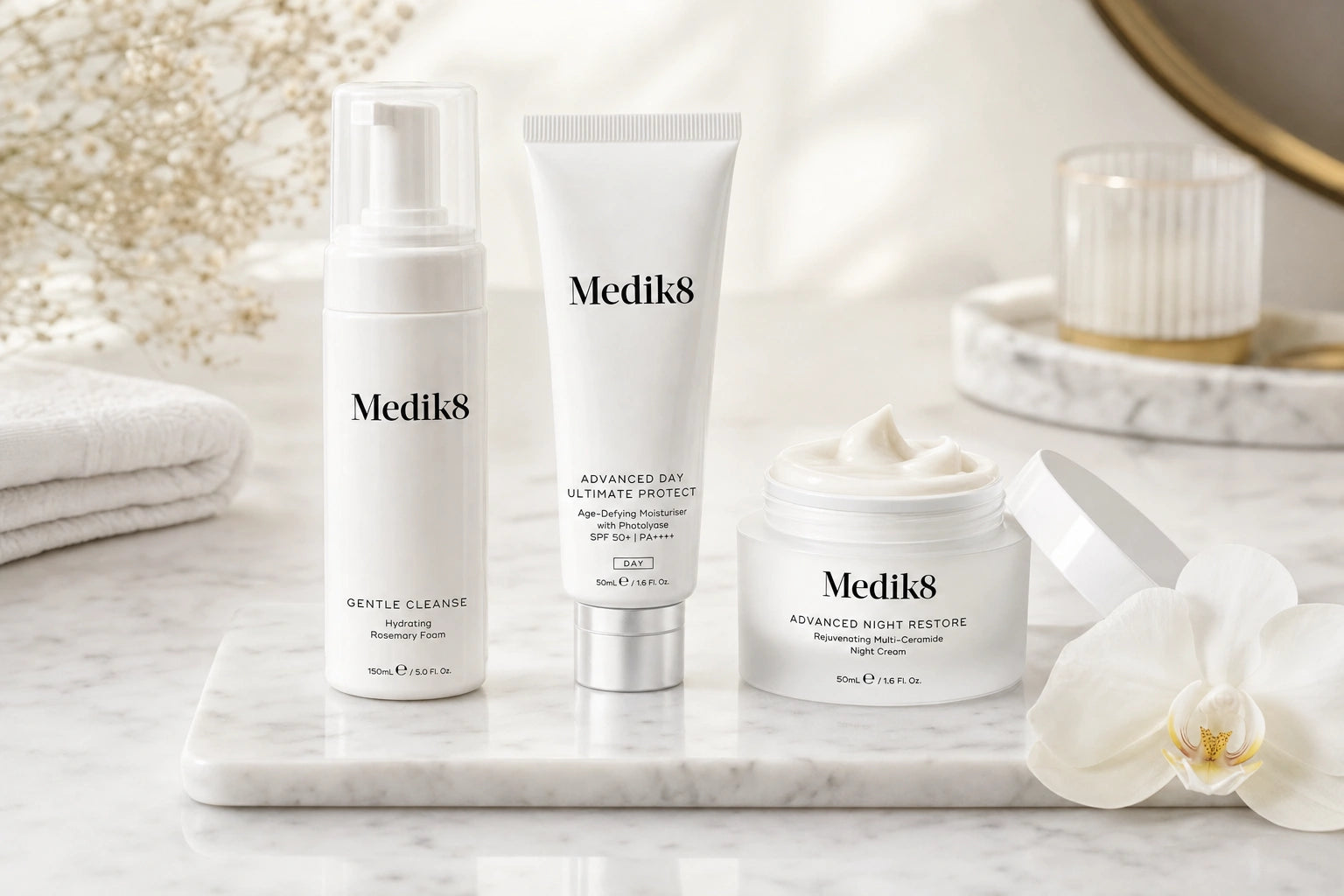
- Cleanse with Gentle Cleanse — rinse thoroughly, pat completely dry.
- Wait five minutes. Skin must be bone-dry before retinoid application.
- Apply Intelligent Retinol 3TR — pea-sized amount, dot across forehead, cheeks, chin. Spread evenly, avoid eye area.
- Optional: layer Advanced Night Restore on top for added barrier support if skin feels tight.
Frequency: twice weekly weeks 1–2, three times weekly weeks 3–4, four times weekly weeks 5–6, nightly weeks 7+. If flaking appears at any point, reduce frequency and add the buffering step (apply retinoid after moisturizer instead of before).
Morning protection essentials
- Rinse with lukewarm water — no cleanser needed in the morning unless you applied an occlusive the night before.
- Apply antioxidant serum — C-Tetra or C-Tetra Luxe for environmental protection.
- Finish with Advanced Day Ultimate Protect SPF 50 — retinoids increase sun sensitivity, so SPF isn't optional.
Daily SPF is mandatory when using any retinoid. Skipping it undoes everything the retinoid is trying to achieve and adds photo-damage on top.
What Makes Medik8 Professional-Grade (and Worth the Price)
Stability testing. Retinol and retinaldehyde are notoriously unstable — they degrade rapidly when exposed to light, air, or heat. Professional brands invest in airless packaging and encapsulation technology to keep the active intact from manufacture to application. Mass-market brands often skip this step, which is why that department-store retinol might irritate without delivering results.
Active concentration transparency. When Medik8 lists 0.3% retinol on the label, you're getting 0.3% retinol — not a proprietary blend with trace amounts or less stable retinyl palmitate derivatives padded with fillers. This matters for dose consistency and predictable results.
Strength progression protocols developed with dermatologists. The graduated system isn't arbitrary — it's mapped to typical enzymatic adaptation timelines and barrier recovery cycles. You're following a clinical framework, not a marketing gimmick. For more on how retinol works in skin at the cellular level, we've covered the full mechanism elsewhere.
Compare briefly to mass-market: most don't disclose concentration, use less stable derivatives, and lack time-release delivery. You're paying more upfront, but you're not wasting months on a formula that degrades before you finish the bottle. To understand why SPF is non-negotiable with retinoids, especially in Southern Europe, check our year-round SPF guide.
FAQ: Medik8 Retinol & Retinal
Is Medik8 retinol any good?
Medik8's formulas use Time Release Technology to minimize irritation while delivering results over weeks, not months. The brand formulates at transparent concentrations and is distributed through aesthetic clinics. Crystal Retinal converts to retinoic acid 11× faster than standard retinol due to its one-step enzymatic pathway, making it effective for experienced users who've built tolerance.
How strong is Medik8 retinol?
The Intelligent Retinol line offers 0.3%, 0.6%, and 1.0% encapsulated retinol. Crystal Retinal provides 0.01%–0.2% retinaldehyde, which is more potent due to one-step conversion to retinoic acid versus retinol's two steps. Beginners should start with Intelligent Retinol 3TR or Crystal Retinal 1 depending on sensitivity history — never jump to high strength without building enzymatic capacity first.
What's the difference between Medik8 Crystal Retinal and Intelligent Retinol?
Crystal Retinal uses retinaldehyde, converting to retinoic acid in one enzymatic step for faster visible results in texture and tone. Intelligent Retinol uses encapsulated retinol with a two-step conversion pathway, making it gentler for retinoid-naive or reactive skin. Both feature Time Release Technology to reduce irritation, but retinaldehyde acts 11× faster due to its enzymatic proximity to the active form.
Can I use Medik8 retinol every night?
Not immediately. Start with twice-weekly application for four to six weeks, then gradually increase frequency over the next six to eight weeks. Most users tolerate nightly application after building enzymatic capacity progressively. The Time Release Technology reduces irritation compared to immediate-release formulas, but gradual introduction prevents barrier damage and flaking. Always use SPF 30+ daily when using any retinoid — photosensitivity is unavoidable.
Medik8's strength-ladder approach works — but only if you respect the ladder. Start low, build slowly, and let your skin adapt at its own pace. The results you want are three months away, not three days. More on structuring a complete retinol routine structure beyond just the active itself in our retinol routine guide.