Cart
0
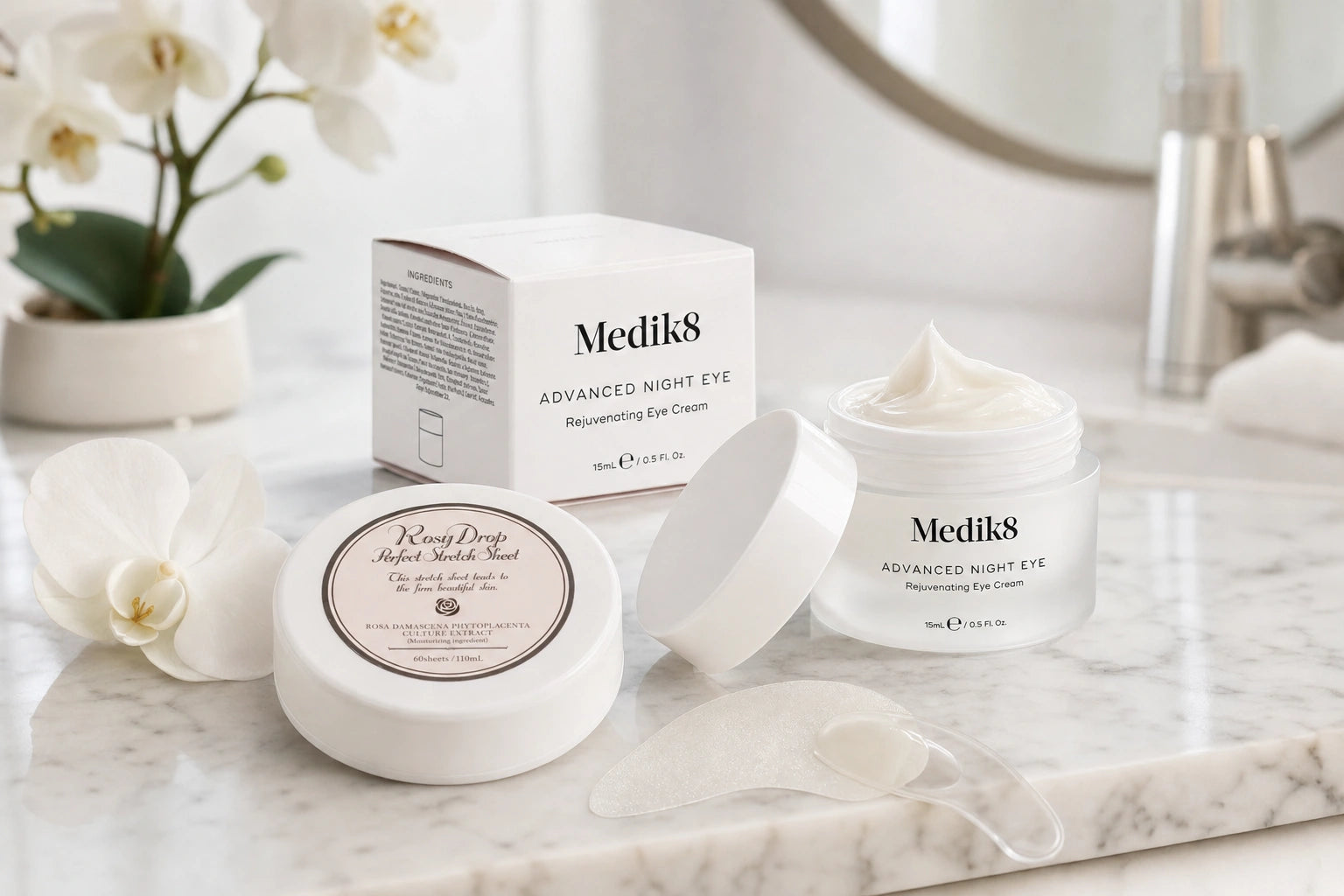
You're looking at an eye patch that costs €2 per use and comes with precision tweezers. The Rosy Drop Stretch Sheets aren't your standard under-eye gels — they're engineered with a geometric slit-and-cutout design that treats both the under-eye area and nasolabial folds in a single 20-minute session. This Japanese formulation uses what the manufacturer calls Balloon Compression Technology, rose stem cells, and three growth factors to deliver visible hydration where mature skin shows it first.
Most clients ask me why this costs ten times more than drugstore patches. The answer: you're paying for dual-zone coverage and a delivery system designed to keep moisture particles in the stratum corneum for up to two weeks, according to manufacturer claims. Whether that justifies the price depends entirely on how you use it — and that's what we'll cover here.
What Makes Rosy Drop Different (And Why It Has Tweezers)
The Geometric Shape: Slits, Cutouts, and Why It Looks Like That
Standard hydrogel patches are crescent-shaped — one zone, one use. Rosy drop eye patches have a slit that anchors at your outer eye corner and a cutout that positions at the nostril edge. You're meant to apply it under one eye for 10 minutes, then remove and reposition the same patch along your nasolabial fold for another 10 minutes.
The tweezers aren't decorative. Precise placement matters — if the slit doesn't catch the outer corner or the cutout misses the nostril anchor point, the patch won't stretch the laugh line effectively. I've watched clients skip the tweezers and end up with a bunched patch that delivers uneven serum distribution. Use them.
Balloon Compression Technology: The 10-Minute Plumping Mechanism
BCT is the brand's proprietary delivery term for expanded moisture particles that create visible plumping within 10 minutes. The manufacturer claims these particles remain in the stratum corneum for up to two weeks until natural skin turnover cycles them out. What you'll see immediately is hydration — the kind that smooths dehydration lines and makes the under-eye look fresher for the next 4–8 hours.
Long-term retention is harder to verify without biopsy, but the concept aligns with occlusive delivery: saturate the skin, trap moisture, let the barrier hold it. This isn't correction — it's intensive hydration with stem-cell actives layered in.
The 20-Minute Protocol: Under-Eye First, Then Nasolabial Folds
Here's where clients get confused. You're not using two patches simultaneously on both eyes. The protocol is sequential:
- Apply one patch under your right eye (slit at outer corner). Leave 10 minutes.
- Remove that patch and reposition it along your right nasolabial fold (cutout at nostril). Leave 10 minutes.
- Repeat steps 1–2 on the left side.
Total treatment time: 40 minutes if you're doing both sides. If you only care about under-eye hydration, you can stop after step 1 on each side — but you're leaving half the design unused.
I see this misunderstanding on consult almost weekly. Clients think it's 10 minutes total, then wonder why only one eye is done. Read the protocol twice before starting.
The Active Lineup: Rose Stem Cells, Peptides, and Three Growth Factors
The serum pre-soaking these patches includes:
- Rosa Damascena Phytophcenta Culture Extract — rose stem cell technology formulated to support skin's natural renewal
- Acetyl Decapeptide-3 — a peptide compound
- Resveratrol from Vitis Vinifera (grape) extract, an antioxidant
- Dipotassium Glycyrrhizate — derived from licorice root, formulated to soothe visible redness
- Three growth factors (specific forms not disclosed by the manufacturer)
The hydration base is glycerin, butylene glycol, pentylene glycol, and betaine — a standard humectant stack you'd find in professional serums. The actives are what you're paying for: rose stem cells and growth factors aren't common in €1 patches.
What You'll Actually See (And What You Won't)
Immediate results: visible plumping, smoother-looking texture, temporary softening of dehydration lines. This lasts 4–8 hours — perfect pre-event or post-flight.
After 2–4 weeks of use at 2× weekly: may help support smoother skin texture and reduced appearance of fine lines where dehydration was the primary driver. If your lines are static wrinkles (visible even when skin is hydrated), this won't erase them. That's retinoid and peptide serum territory.
What it won't do: lift sagging, correct pigmentation, replace your nightly retinol routine for smoother, brighter skin. Clients in their 50s often expect structural changes from a patch — I explain this is hydration support, not architectural correction. Manage expectations before you spend €120.
When You'd Use This (And When You'd Skip It)
Best scenarios:
- Pre-event prep (wedding, photoshoot) when you need immediate plumping
- Post-flight puffiness and visible dehydration
- Post-procedure downtime when retinoids and acids are off-limits but you want active delivery
- Maintenance for clients prioritizing under-eye and nasolabial hydration 2× weekly
Skip if your concern is pigmentation (use a vitamin C serum instead), static wrinkles (retinoids deliver better ROI), or barrier damage (this isn't occlusive enough for repair). At €2 per patch, position it as an adjunct to your serum routine — not a replacement.
A Twice-Weekly Routine with Rosy Drop Patches (Dry, Mature Skin)
This routine assumes you're already using professional serums and want to add intensive hydration treatments twice weekly. Before adding any new active, patch test on the inner forearm for 48 hours.
Sunday and Wednesday evenings:
- Cleanse and pat dry.
- Apply Rosy Drop Stretch Sheets: under-eye 10 minutes, then reposition on nasolabial fold for 10 minutes. Repeat on the other side.
- Remove patches and pat remaining serum into skin.
- Wait 5 minutes (prevents pilling), then apply Advanced Night Eye around the orbital bone — this retinol-optimized eye cream smooths the look of fine lines and visibly brightens under-eye darkness overnight.
- Layer your face moisturizer on the rest of your face and neck.
All other nights (Monday, Tuesday, Thursday, Friday, Saturday):
- Cleanse and pat dry.
- Apply Advanced Night Eye around the orbital bone.
- Follow with your face serum and moisturizer as usual.
Every morning:
- Cleanse.
- Apply C-Tetra Eye or your preferred antioxidant eye serum.
- Follow with SPF 30+ on face and neck — retinoids increase sun sensitivity, so daily UV protection is non-negotiable in Mediterranean climates like Portugal, Spain, Italy, and France.
The patches deliver hydration twice weekly. Your retinoid eye cream runs nightly on non-patch nights — that's where you're building long-term texture improvement. For more strategies on managing tired-looking skin, see our guide to professional eye care solutions for tired-looking skin.
Rosy Drop vs Standard Hydrogel Patches: The €100 Price Gap
| Feature | Standard Hydrogel | Rosy Drop Stretch Sheets |
|---|---|---|
| Price per patch | €0.30–€1 | €2 |
| Coverage | Under-eye only | Under-eye + nasolabial fold (dual-zone) |
| Actives | Hyaluronic acid, glycerin | Rose stem cells, peptides, growth factors, resveratrol |
| Delivery tech | Occlusion | BCT (Balloon Compression Technology) |
| Wear time | 15–20 minutes, single zone | 20 minutes total (10 min per zone, sequential) |
The premium you're paying: geometric engineering for dual-zone fit, professional-grade active concentration, and Japanese formulation standards. Not better or worse — different use case. Most clients don't need this daily. It's a 2× weekly intensive for those who want targeted nasolabial and under-eye treatment in one product.
Who Should (And Shouldn't) Try Rosy Drop Patches
Best candidates:
- Ages 35–60 with visible under-eye dehydration lines and nasolabial fold concerns
- Pre-event hydration needs (weddings, shoots, important meetings)
- Clients already using professional serums who want an adjunct treatment
- Post-procedure recovery when actives are temporarily off-limits
Skip if:
- You're under 30 with no nasolabial concern — the dual-zone design is wasted on you
- Your primary goal is pigmentation correction (wrong tool — see anti-aging eye routine for sensitive skin for brightening options)
- You're on a budget — start with a retinoid eye serum for far better long-term ROI
Contraindications: Active periorbital dermatitis, open skin, or retinoid adjustment phase (too much at once). If standard hydrogel patches cause redness, test these on your inner forearm first — rose extract can irritate sensitive types.
FAQ
What are Rosy Drop eye patches?
Japanese eye patches with a geometric slit-and-cutout design that treats both under-eye area and nasolabial folds sequentially. Each patch uses Balloon Compression Technology to deliver rose stem cells, peptides, and growth factors over a 20-minute protocol — 10 minutes under the eye, then repositioned for 10 minutes along the laugh line.
Do under eye patches actually work?
They deliver immediate hydration and temporary plumping that lasts 4–8 hours — ideal pre-event or post-flight. For lasting wrinkle improvement, you need actives like retinoids or peptide serums applied daily. Patches are an adjunct, not a replacement. The visible benefit depends on formulation quality and how dehydrated your skin is to start.
Are expensive eye patches worth it compared to drugstore versions?
Rosy drop stretch sheets eye patches (€2 each) include rose stem cells, peptides, growth factors, and engineered delivery systems. Drugstore patches (€0.30–1) offer basic hydration. If your routine already includes professional serums, expensive patches add minimal benefit. They're worth it for specific events or as a 2× weekly intensive, not daily use.
Can you reuse eye patches on different face areas?
Balloon compression technology eye patches are designed for sequential dual-zone use — under-eye first, then repositioned on the nasolabial fold within the same 20-minute session. You don't reuse across days. Standard single-zone patches aren't engineered for repositioning and lose adhesion after 15–20 minutes, so reuse isn't effective or hygienic.
Japanese eye patches rose stem cells technology delivers intensive hydration where mature skin needs it most — under the eyes and along nasolabial folds. At €2 per patch, this isn't a daily habit. It's a targeted treatment for clients who understand that hydration supports skin appearance but doesn't replace corrective actives. If you're already running retinoids nightly and want a twice-weekly boost for visible dehydration, the dual-zone design makes sense. If you're looking for your first eye treatment, start with a serum — then add patches later.
Under eye patches with tweezers require precision, patience, and realistic expectations. Position them correctly, and you'll see why the geometric shape exists.