Cart
0
You've just had a peel — or your skin decided to flare after three days on the Algarve coast. Either way, you need more than a basic hydrating sheet mask.
The ASCE Plus Soothing Gel Mask sits in that narrow space between standard calming masks and clinical recovery protocols. It's formulated with rose stem cell exosomes — lipid-bilayer delivery vehicles extracted via ExoCoBio's patented ExoSCRT™ technology — and a triple-cica complex designed to support visible comfort without crossing into therapeutic territory.
Here's what you're actually paying for, when you'd use it, and what it won't do.
What Makes This Mask Different (And Why It Costs More)
Most sheet masks deliver hydration via a cotton or cellulose base soaked in watery essence. The ASCE Plus mask uses a cupra sheet saturated with a gel-textured concentrate containing rosa damascena callus extracellular vesicles — the formal term for rose stem cell exosomes.
The ExoSCRT™ Extraction: What Rose Stem Cell Exosomes Actually Are
Exosomes are nano-sized vesicles (30–150 nanometers) that cells use for intercellular communication. They're enclosed in lipid bilayers similar to cell membranes, which allows them to encapsulate and transport active molecules. ExoCoBio's patented extraction method isolates these vesicles from Damascus rose stem cells and purifies them for cosmetic use.
You're not paying for rose water — you're paying for the delivery system. The exosomes contain growth factors, proteins, microRNAs, and lipids formulated to support skin's natural renewal processes within cosmetic boundaries. This isn't a treatment for cellular damage; it's designed to help skin look calmer and recover its baseline comfort faster.
Gel Texture + Cupra Sheet = Better Delivery
Standard sheet masks use watery essences that begin evaporating the moment you open the packet. The gel formula here stays viscous throughout the 10–20 minute application window, maintaining full contact with skin. The cupra base (a regenerated cellulose fiber) adheres better than cotton, reducing air pockets that compromise delivery.
Price comparison: this mask retails around €9–10 per sheet. Pharmacy options run €2–3. The difference lies in raw-material quality, the patented extraction, and clinical design. Pharmacy masks hydrate. Professional masks support recovery.
The Ingredient Architecture: How It Soothes on Three Levels
Triple-Cica Complex (Centella + Asiaticoside + Madecassoside)
Centella asiatica extract appears alongside two of its isolated active compounds: asiaticoside and madecassoside. This isn't redundant formulation — it's strategic layering. The whole-plant extract provides a broad spectrum of triterpenoids, while the isolated compounds deliver higher concentrations of the specific molecules associated with visible soothing.
In Mediterranean climates (Portugal, Spain, Italy, France), where UV intensity runs high even in shoulder seasons, reactive skin often shows visible redness. The cica trinity is formulated to support barrier function and help skin look less inflamed.
Supporting Cast: Niacinamide, Copper Peptide, Chamomile
Niacinamide sits at the intersection of barrier support and visible tone evening. Here, it's positioned for the former — helping maintain the skin's protective function during the recovery window.
Copper tripeptide-1 supports skin renewal. Chamomilla recutita (matricaria) flower extract and rosa damascena flower water layer in additional soothing properties, with the rose hydrosol contributing the mask's signature light floral scent.
Sodium hyaluronate maintains hydration during treatment, while adenosine supports visible smoothness. The formula is fragrance-free beyond the natural botanicals — no essential oils that could further sensitize compromised skin.
When You'd Reach for This (And When You Wouldn't)
This is a treatment mask, not a daily hydrator. I see it most often in three scenarios:
- Post-procedure recovery: 24–48 hours after peels, microneedling, or laser. Skin looks visibly inflamed and needs immediate soothing support.
- Reactive episodes: Your skin decided to flare after travel, hormonal shifts, or environmental stress (think three days in Lisbon sunshine without adequate SPF reapplication).
- Weekly maintenance for sensitive types: 1–2× weekly for those whose baseline runs reactive — rosacea-prone, barrier-compromised, or chronically sensitized skin.
Clients booking summer facials in Lisbon often ask for this in the recovery protocol. The immediate cooling sensation registers within seconds, and visible redness calms noticeably over the 15-minute application window.
What it won't do: substitute for a proper barrier-repair routine if your baseline is compromised. If you're reaching for soothing masks more than twice weekly, you need to address the underlying barrier dysfunction — not just treat the symptoms. This mask supports recovery; it doesn't prevent the next flare if your daily routine is stripping your skin.
How to Use It (The 10–20 Minute Window)
The gel doesn't evaporate like watery essences, so you get the full treatment duration without the mask drying out halfway through.
- Cleanse skin thoroughly — no actives, no acids, just a gentle surfactant-based cleanser
- Remove the protective film from the sheet and unfold the mask
- Apply to face, smoothing from center outward to eliminate air pockets
- Leave on for 10–20 minutes (I typically recommend 15 for most clients)
- Remove the sheet and use light fingertip tapping to help the remaining gel essence absorb
- Follow immediately with an occlusive moisturizer or balm to seal in the treatment
Evening application is preferred. Your skin enters its overnight repair cycle, and the exosome delivery syncs with that natural process.
In ASCE Plus's own protocol architecture, the mask sits between their SRLV serum and EXOBALM. That's serum → treatment mask → occlusive balm. The mask is the treatment step — not a standalone product.
A Post-Procedure Recovery Routine with the Soothing Gel Mask
This is what I hand clients walking out after a medium-depth peel or microneedling session. Evening only for the first 48 hours — your skin is in active recovery and can't tolerate a full routine yet.
Before adding any new active, patch test on the inner forearm for 48 hours.
Evening (Days 1–3 post-procedure):
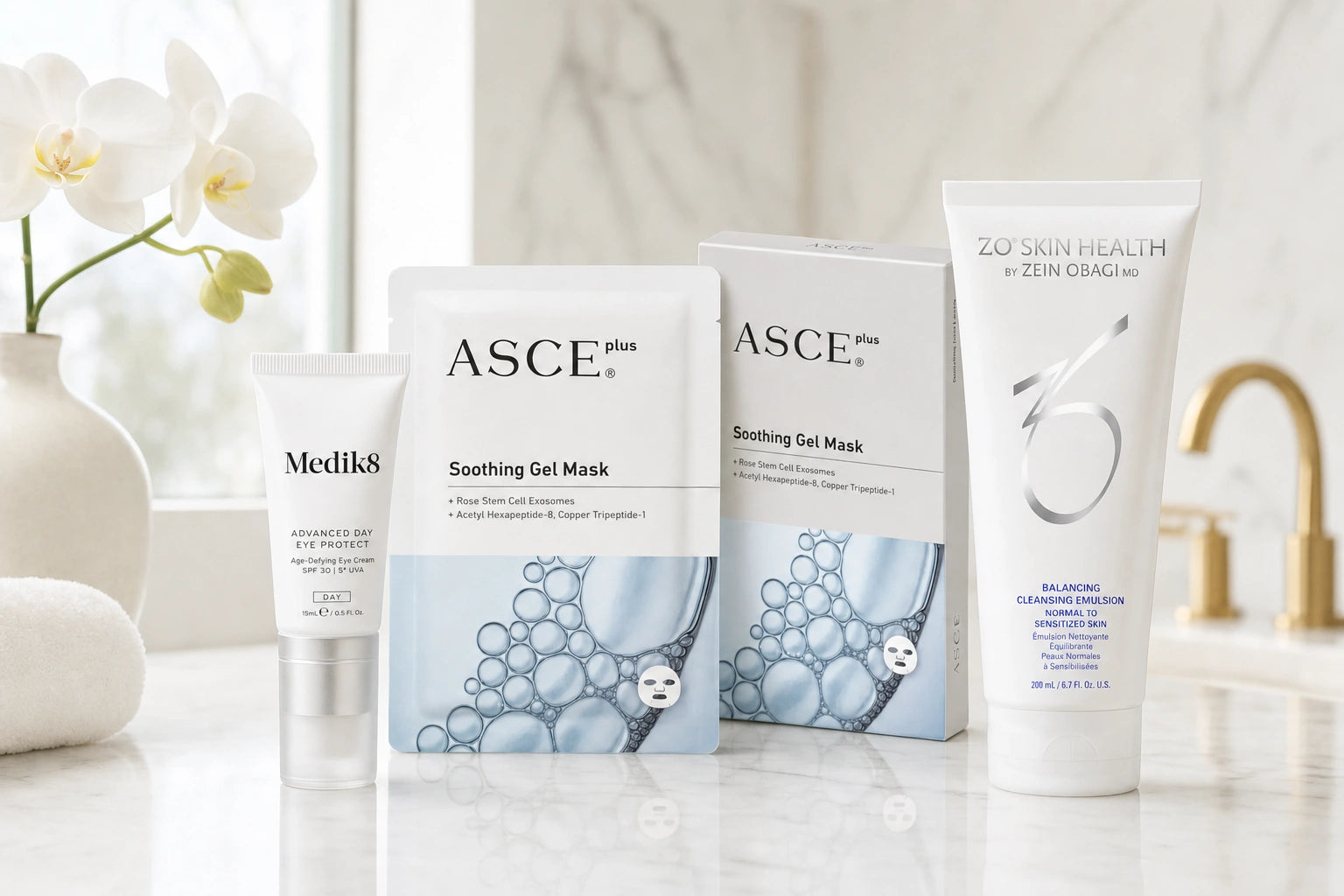
- Cleanse with ZO Balancing Cleansing Emulsion — this is a conditioning gel-to-milk formula with no sulfates, no fragrance, designed explicitly for sensitized skin
- Apply the cooling gel sheet mask for 15 minutes
- Remove mask and gently tap in remaining gel essence — don't rinse
- Seal with iS Clinical Sheald Recovery Balm — a moisture-rich formula that supports barrier function while botanical extracts help relieve visible discomfort
Morning (Days 1–3 post-procedure):
- Gentle cleanse with lukewarm water (no cleanser if skin feels too sensitive)
- Medik8 Advanced Day Eye Protect on eye area — SPF 30 with 5-star UVA protection, fragrance-free, designed for the delicate eye zone
- Apply a full-face mineral SPF 30+ (mandatory after any resurfacing procedure — retinoids, AHAs, BHAs, and exfoliating treatments all increase photosensitivity, so daily SPF 30+ is non-negotiable)
Critical safety note: No actives — retinoids, acids, vitamin C — for 48–72 hours post-procedure. Your barrier is compromised. Let it recover before reintroducing exfoliants.
After day 3, you can begin phasing back into your regular routine, but keep the mask in rotation 2× weekly for the first two weeks post-treatment.
Professional-Grade Sheet Masks vs Pharmacy Brands
The €7 price gap between this and a drugstore sheet mask comes down to three factors: raw-material sourcing, extraction technology, and delivery design.
Pharmacy masks hydrate. They're cotton or cellulose soaked in hyaluronic acid, glycerin, maybe some panthenol. They work for basic moisture replenishment. You're paying €2–3 for hydration delivery.
The ASCE Plus mask uses ExoCoBio's worldwide-patented ExoSCRT™ extraction to isolate rose stem cell exosomes. The cupra sheet is engineered for better adherence. The gel formula is designed to maintain viscosity throughout the treatment window. You're paying €9–10 for a recovery-focused delivery system with clinical design backing.
This isn't an attack on pharmacy options. They have their place. If you need general hydration and your skin baseline is stable, a €3 mask works fine. If you're 36 hours post-peel with visible inflammation, you need something built for that specific recovery window.
Professional brands like ASCE Plus, iS Clinical, and Medik8 invest in raw-material quality, delivery technology, and formulation architecture that standard retail can't match at their price points. The difference shows in outcome consistency.
What You'll See (And What You Won't)
Immediate (within application): Cooling sensation registers in 10–15 seconds. Visible redness calms noticeably by the time you remove the sheet at the 15-minute mark. Skin feels plumper, less tight.
Over 1–2 weeks (with 2× weekly use): Smoother texture. Skin looks less reactive day-to-day — fewer random flare episodes, faster recovery when irritation does occur.
What it won't do: Reverse chronic rosacea. Eliminate deep pigmentation. Replace a prescription barrier-repair protocol if your skin is clinically compromised. This is a support step formulated to help skin look calmer and recover faster — not a standalone solution for pathological barrier dysfunction.
The most dramatic results I see are in the 48-hour post-peel window. Clients who use this mask in that recovery phase show visibly less inflammation and return to baseline faster than those who skip straight to moisturizer. It's not magic — it's targeted delivery at the right intervention point.
Frequently Asked Questions
Are gel masks good for your face?
Gel masks deliver hydration and soothing actives without occlusion, making them excellent for sensitized or post-procedure skin. The gel texture adheres well and prevents premature evaporation. Use 1–2× weekly — not daily — as they're treatment steps, not basic moisturizers.
What is the best face mask for treating rosacea?
Masks don't treat rosacea — they support visible comfort. Look for cica-based formulas (centella asiatica, madecassoside) with no fragrance or essential oils. The ASCE Plus mask and Medik8 Ultimate Recovery are clinic standards for reactive skin experiencing visible redness. For more barrier-support options, see our guide to moisturizers for redness relief.
What are exosome face masks?
Exosome masks contain extracellular vesicles derived from plant or human stem cells. These lipid-bilayer capsules deliver active molecules into skin. ASCE Plus uses rose stem cell exosomes extracted via ExoCoBio's patented ExoSCRT™ technology to support skin's natural renewal processes within cosmetic boundaries.
How often should you use a soothing gel mask?
1–2× weekly for maintenance, or as needed after professional treatments like peels or microneedling. Post-procedure, use for 2–3 consecutive evenings, then return to weekly frequency. Overuse won't accelerate results — these are treatment steps, not daily hydrators. For complete post-treatment protocols, see our masques for stressed skin recovery guide.
Can I use this mask if I have sensitive skin?
Yes — it's designed for reactive and sensitized skin types. The triple-cica complex and rose stem cell exosomes are formulated to support visible comfort. No fragrance beyond natural botanicals, no essential oils. If you're uncertain, patch test on the inner forearm for 48 hours before full-face application. Our iS Clinical hydration solutions article covers additional options for sensitive types.
The ASCE Plus Soothing Gel Mask isn't a daily essential — it's a recovery tool. You reach for it when your skin crosses from baseline into visible distress, or when you're 24 hours post-procedure and need targeted soothing support.
If you're using it more than twice weekly, step back and assess your daily routine. Reactive skin that needs constant intervention is telling you the baseline protocol isn't working.