Cart
0
You've seen "broad spectrum" on every sunscreen label, but do you know what it actually protects you from? It's not just marketing — it's the difference between blocking surface burns and preventing the deep photoaging that shows up as pigmentation, fine lines, and sagging years later. Broad spectrum means the formula shields against both UVA rays (the aging wavelengths that penetrate deep) and UVB rays (the burning wavelengths that damage the surface). If your SPF doesn't say broad spectrum, you're only getting half the protection you need.
What Broad Spectrum Actually Means
UVA vs UVB: The Difference That Matters
UVA rays (320–400 nm) penetrate deeper than UVB, reaching the dermis where collagen and elastin live. They don't cause immediate burns, but they trigger oxidative stress, melanin production, and DNA damage that accumulates over decades. This is the wavelength behind hyperpigmentation, loss of firmness, and visible aging.
UVB rays (290–320 nm) hit the epidermis — the surface layer. They cause sunburn, direct DNA mutations, and are the primary driver of skin cancer risk. You feel UVB exposure immediately as redness or pain.
Broad spectrum formulas block both. But here's the catch: SPF ratings measure UVB protection only. A product can claim SPF 50 and still deliver weak UVA coverage. That's why clients ask, "Why do I tan through my SPF 30?" — they're getting UVB block (no burn) but insufficient UVA defense (melanin still activates).
EU Sunscreen Standards and UVA Circle Symbol
The EU requires stricter UVA standards than the US. To earn the UVA circle logo on European products, a sunscreen must provide UVA protection equal to at least one-third of its labeled SPF. An SPF 30 with the circle guarantees UVA-PF 10 minimum. This ensures balanced coverage — you're not just blocking burns while aging accelerates underneath.
Always check for that circle. It's your fastest quality filter.
Why Broad Spectrum Matters
UV Index Reality in Portugal, Spain, Italy, France
Southern European UV index reaches 8–11 routinely during warm months — classified as very high to extreme. At those levels, unprotected skin burns in under 15 minutes. But even on overcast days in winter, UVA remains constant. Diffey (2002), Physics in Medicine & Biology, demonstrated that UVA accounts for 95% of UV reaching skin through cloud cover. You don't see it, you don't feel it, and it doesn't stop.
Clients in Lisbon and Barcelona often present with melasma concentrated on one side of the face — the side facing the car window during their commute. UVA penetrates glass effortlessly. Office workers sitting near windows accumulate daily low-level exposure that manifests as uneven tone by their mid-30s. Year-round application isn't optional at these latitudes; it's baseline maintenance.
Year-Round UVA Exposure
Unlike UVB, which peaks midday in summer, UVA intensity stays relatively stable across seasons and hours. Winter UVA in Madrid is still strong enough to darken existing pigmentation or prevent brightening actives from working. If you're using vitamin C or retinoids to address tone, skipping daily SPF sabotages the entire routine. Read more about why year-round SPF is essential.
Mineral vs Chemical Broad Spectrum Formulas
Physical Blockers: Zinc Oxide and Titanium Dioxide
Mineral sunscreens sit on the skin surface and reflect UV rays. Zinc oxide alone covers the full UVA and UVB spectrum (290–400 nm) — it's the only single-ingredient broad spectrum filter. Titanium dioxide covers UVB well but has a UVA gap around 340–400 nm, so most formulas combine both minerals for complete protection.
Mineral filters work immediately on application. No wait time. They're ideal for sensitive, reactive, or rosacea-prone skin because they don't absorb into tissue or trigger inflammatory pathways.
Chemical Absorbers: Avobenzone, Tinosorb, Mexoryl
Chemical filters absorb UV energy and convert it to heat. Because no single chemical covers the full spectrum, formulas typically layer 2–3 actives: avobenzone for UVA, octocrylene or homosalate for UVB, often stabilized with newer broad-spectrum filters like Tinosorb S or Mexoryl XL.
These formulas feel lighter and blend invisibly, which makes them popular for oily or acne-prone skin. They require 15–20 minutes to activate after application — plan accordingly before sun exposure.
Which One for Your Skin Type
Sensitive or compromised skin (post-peel, rosacea, eczema) → mineral. Oily, acne-prone, or those who layer makeup → chemical often feels more comfortable. There's no universal winner; it's texture preference and tolerance.
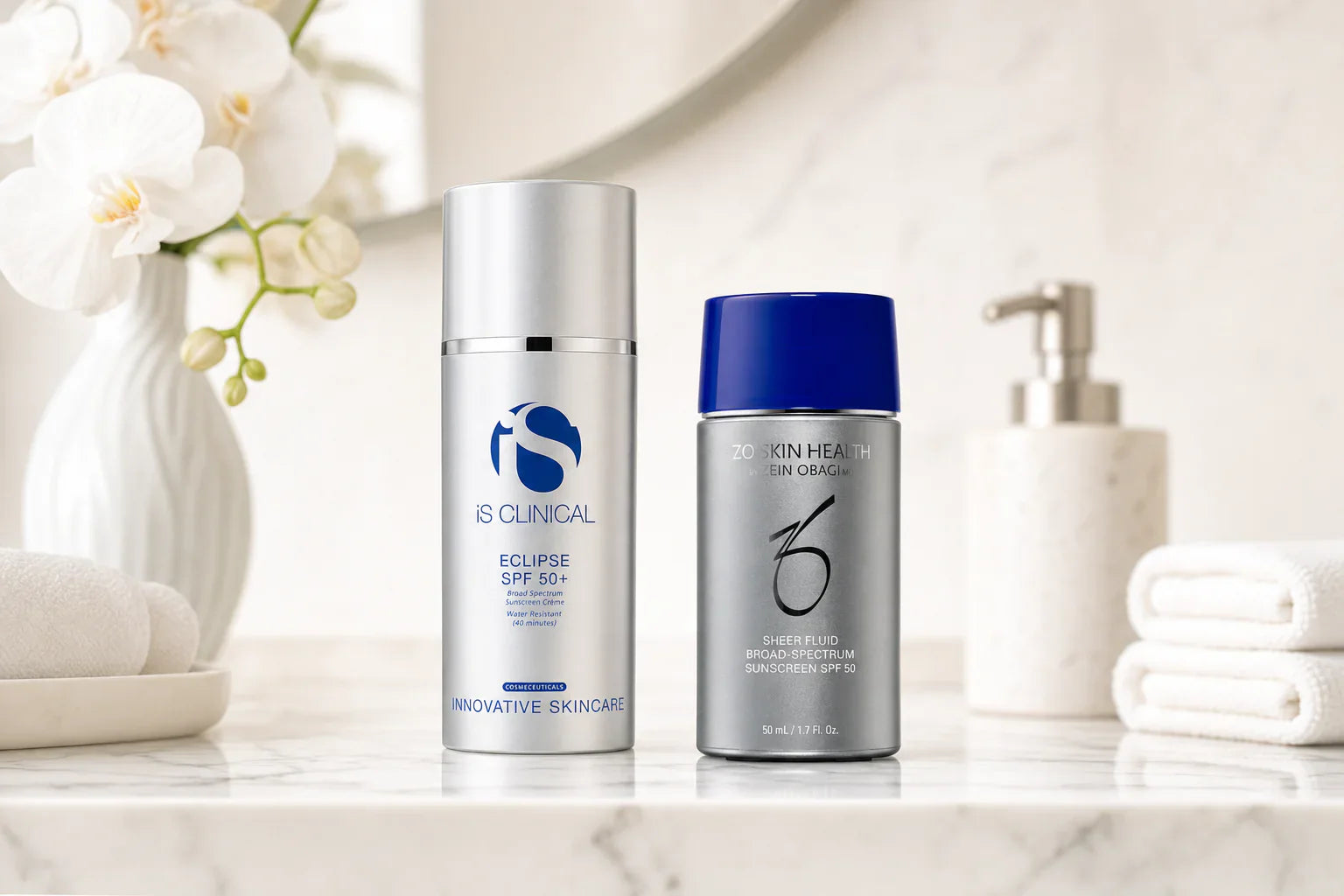
Compare ZO Sheer Fluid SPF 50 (mineral, matte finish, fragrance-free) to Eclipse SPF 50+ (also mineral, ultra-sheer with vitamin E). Both deliver complete UVA/UVB protection — the difference is weight and finish.
How to Choose a Broad Spectrum Sunscreen
SPF Number vs UVA Rating
SPF measures UVB-only. Look for a separate UVA indicator: the EU circle logo, PA++++ rating (Asian standard), or stated UVA-PF number. Minimum SPF 30 for daily use; SPF 50 for prolonged outdoor exposure, retinoid users, or active hyperpigmentation treatment. Water resistance (40 or 80 minutes) matters for sports, beach, or heavy perspiration.
Texture and Wearability
You won't reapply a formula you hate wearing. Test finish preferences: matte for oily skin, dewy for dry, tinted for those who want light coverage. Fragrance-free reduces sensitization risk — especially important if you're layering actives underneath.
Antioxidant Support
UV block alone isn't enough. Antioxidants (vitamin E, C, niacinamide) mitigate oxidative stress that escapes the UV filter. Matsui et al. (2009), Journal of Investigative Dermatology, demonstrated that topical antioxidants reduce UV-induced oxidative damage by 40%. Professional formulas layer defense mechanisms — filters plus free-radical scavengers plus DNA-repair support.
Professional Broad Spectrum Formulas: What Sets Them Apart
Professional-grade sunscreens use micronized mineral particles for transparency without compromising coverage, pharmaceutical-purity filters that meet stricter photostability standards, and multi-mechanism protection. Take Eclipse SPF 50+: it combines transparent titanium dioxide and micronized zinc oxide with pure vitamin E, delivering water-resistant broad spectrum UVA/UVB protection for 80 minutes. The formula absorbs quickly with a non-greasy matte finish — designed for daily use and extended outdoor activities.
Many professional brands publish independent photostability data showing their filters maintain efficacy under prolonged UV exposure, unlike some mass-market formulas that degrade within an hour. They're also formulated for post-procedure skin — safe after peels, laser, or retinoid use when your barrier is compromised. For details on layering SPF with other treatments, see our guide on sunscreen layering for complete UV protection.
Daily Broad Spectrum Routine
Before adding any new active, patch test on the inner forearm for 48 hours. Here's how to integrate broad spectrum protection into your morning sequence:
- Morning cleanse: Use a gentle, pH-balanced cleanser to prep skin.
- Serum layer: Apply any treatment serums (vitamin C, niacinamide, peptides) while skin is still slightly damp.
- Moisturizer (if needed): For dry skin, layer a lightweight hydrator before SPF.
- Broad spectrum SPF 30–50: Apply Eclipse SPF 50+ as your final morning step. Use a nickel-sized amount for face, neck, and décolleté. Don't forget ears and the back of your hands.
- Reapplication: Every 2 hours during prolonged sun exposure. For desk work, once at midday if you're near windows.
If you use retinoids, AHAs, or BHAs at night, SPF 50 minimum in the morning is non-negotiable — these actives increase photosensitivity. Read our article on sunscreen for uneven skin tone to understand how daily SPF accelerates brightening results.
Frequently Asked Questions
What are broad spectrum sunscreens?
Broad spectrum sunscreens protect against both UVA and UVB rays. UVA penetrates deeper, causing photoaging and pigmentation; UVB causes surface burns. In the EU, broad spectrum products must meet strict UVA protection standards — at least one-third of the SPF rating, verified by the UVA circle symbol.
What is a good broad spectrum sunscreen?
A good broad spectrum sunscreen offers SPF 30 minimum, proven UVA coverage (look for the UVA circle in EU products), and comfortable daily wear. Professional formulas like Eclipse SPF 50+ combine physical filters with antioxidants for superior protection beyond basic UV block. Choose texture based on your skin type and reapplication habits.
Can sunscreen remove hyperpigmentation?
Sunscreen doesn't remove existing hyperpigmentation, but it prevents darkening and new spots by blocking the UV exposure that triggers melanin production. Daily broad spectrum SPF is essential when using brightening actives like vitamin C or retinoids — without it, you're undoing your treatment results with every walk outside.
Do I need broad spectrum sunscreen indoors?
Yes, especially near windows. UVA rays penetrate glass and remain constant year-round, even on cloudy days. Clients with office window exposure or long car commutes often develop pigmentation from unprotected UVA. Apply SPF 30 or higher every morning regardless of plans — indoor UVA is real and cumulative.