Cart
0
You've spent enough on serums that promise miracles and deliver nothing. Let's fix that.
The best anti-aging serum isn't the one with the longest ingredient list or the most expensive price tag — it's the one formulated with actives your skin can actually use, in concentrations that work, with delivery systems that get them where they need to go. After twenty years on a treatment bed, I can tell you this: most people are using the wrong actives for their concern, at the wrong time of day, in the wrong order.
Here's what you need to know about retinol serum for wrinkles, vitamin C anti aging formulas, peptide serum benefits, and why professional anti aging products outperform mass-market versions.
What Makes a Serum 'Anti-Aging'?
Anti-aging means supporting visible skin renewal — smoother texture, more even tone, fewer lines. It doesn't mean reversing time or erasing decades overnight.
Serums outperform creams for active delivery because of molecular weight. Smaller molecules penetrate the stratum corneum more effectively. A well-formulated serum delivers actives to the epidermis where they can signal cellular processes — creams sit on top and hydrate.
The Three Mechanisms That Actually Work
Three pathways deliver visible results, backed by current dermatology consensus:
- Collagen support — vitamin C acts as a cofactor in collagen synthesis
- Antioxidant defense — neutralizes free radicals from UV and pollution before they damage cellular structures
- Cellular turnover — retinoids accelerate the skin's natural renewal cycle
Everything else is filler. If a serum doesn't address one of these three, you're paying for a moisturizer with good marketing.
Retinol vs. Retinal vs. Retinoids: Which One You Actually Need
Retinoids aren't one ingredient — they're a family. Your skin converts them into retinoic acid (the active form) at different speeds.
The conversion ladder: retinyl esters → retinol → retinaldehyde → retinoic acid. Each step requires enzymatic conversion. The closer you start to retinoic acid, the faster you see results.
Conversion Speed & Skin Tolerance
Retinol needs two conversions. Retinaldehyde (retinal) needs one — it's 11 times faster. If you've been using drugstore retinol for six months and see nothing, this is why.
Women over 40 often ask me why their retinol stopped working. It didn't — your skin adapted to a low concentration. You need either a higher percentage or a faster-converting form.
When to Choose Retinal Over Retinol
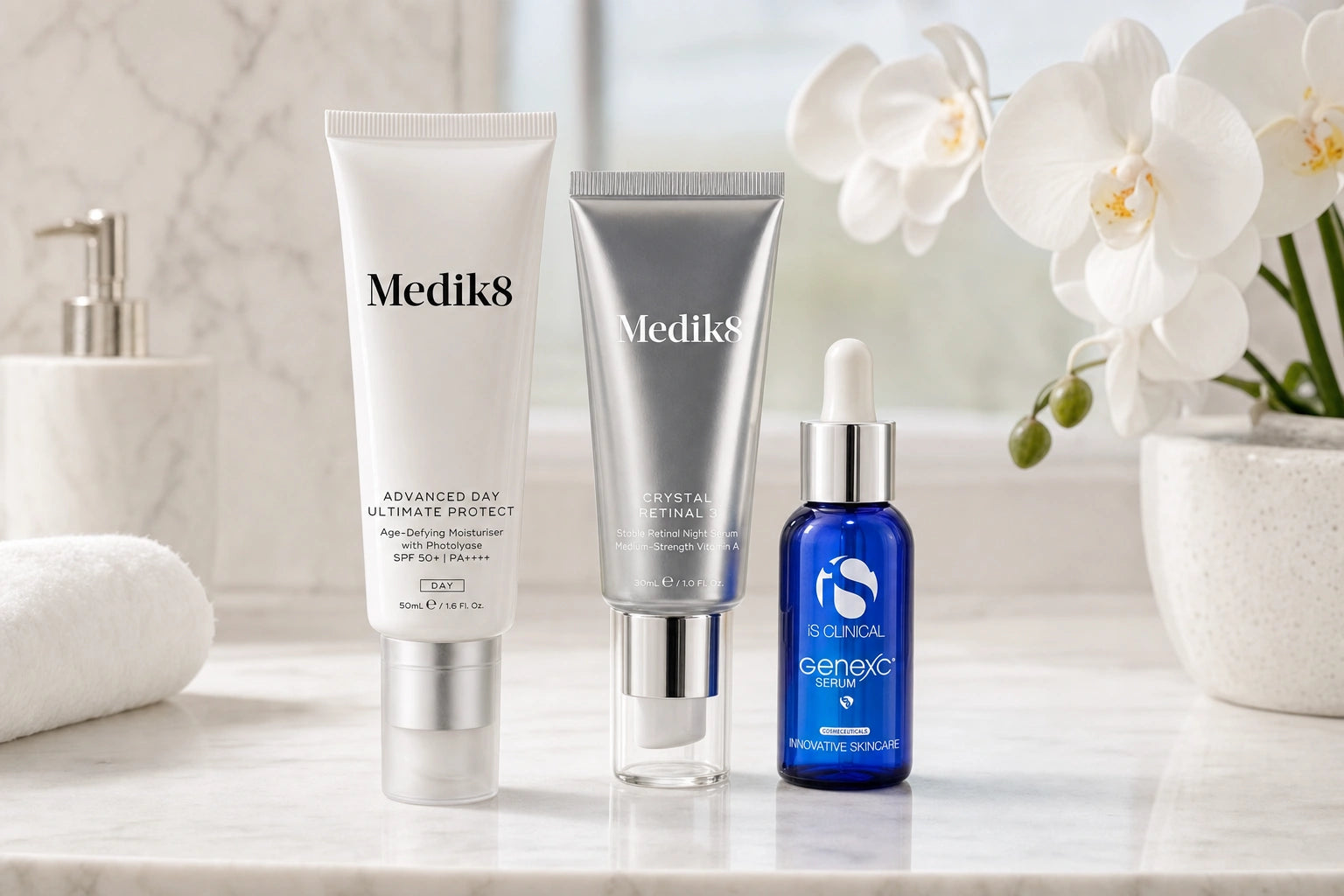
Crystal Retinal 3 delivers 0.03% retinaldehyde with encapsulation technology that minimizes irritation while accelerating results. Start twice weekly in the evening, building to every other night as tolerance increases.
Mandatory safety notes: Retinoids increase photosensitivity — you must wear broad-spectrum SPF 30+ every morning (named product below). Do not use retinoids if you're pregnant or breastfeeding. Before adding any new active, patch test on the inner forearm for 48 hours.
Vitamin C: The Morning Antioxidant That Protects While It Corrects
Vitamin C anti aging formulas work two ways: they neutralize free radicals and they support collagen synthesis. But only if the formulation is stable.
L-Ascorbic Acid vs. Stable Derivatives
L-ascorbic acid is the gold standard — it's the form with the most research. Derivatives like tetrahexyldecyl ascorbate or ascorbyl glucoside are more stable but slower to convert.
Concentration matters. Research suggests 10% L-ascorbic acid delivers measurable photoprotection. Beyond 20%, you hit diminishing returns — more irritation, not more benefit.
Why Formulation pH Decides Everything
L-ascorbic acid only penetrates at pH 3.5 or lower. If the formula isn't acidic enough, you're paying for an expensive moisturizer. Professional formulas stabilize the acid with ferulic acid and vitamin E — that's the difference between a serum that works and one that oxidizes in the bottle.
GeneXC Serum combines 20% L-ascorbic acid with iS Clinical's Extremozyme technology — enzymes that help protect against environmental stressors. Apply it every morning after cleansing, before SPF.
In Portugal, Spain, and Italy, where UV intensity peaks year-round, morning vitamin C isn't optional — it's the first line of defense.
Professional vs. Mass-Market: Why the Price Gap Exists
You're not paying for the brand name. You're paying for what's actually in the bottle.
Professional-grade actives cost more because the raw materials are higher purity. Cosmetic-grade retinol might be 95% pure. Professional-strength retinol is 99%. That 4% matters — it's the difference between visible results in eight weeks and barely noticeable changes in six months.
Stabilization technology costs money. iS Clinical's Extremozymes and Medik8's encapsulation systems require R&D and manufacturing precision that mass-market brands can't justify at their price points. This isn't an attack on drugstore skincare — it's recognizing that different products serve different needs.
Clinical backing is the final piece. Medik8 publishes trials showing Crystal Retinal delivers results 11 times faster than retinol. ZO Skin Health demonstrates wrinkle reduction in controlled studies. That level of validation requires investment.
A Real Anti-Aging Serum Routine (Not a 12-Step Fantasy)
You don't need twelve products. You need the right three, used consistently.
Daily Morning Routine
- Cleanse with a gentle, pH-balanced cleanser
- Apply GeneXC Serum — 2–3 drops, pressed into clean skin
- Follow with Advanced Day Ultimate Protect SPF to shield against UV damage while delivering hydration
Evening Routine (Twice Weekly to Start)
- Cleanse thoroughly
- Apply Crystal Retinal 3 — one pump, avoiding the eye area
- Wait 20 minutes, then apply a barrier-supporting moisturizer if needed
Off-Nights
On evenings when you're not using retinal, cleanse and moisturize. That's it. Your skin needs recovery time.
Photosensitivity reminder: Retinaldehyde increases sun sensitivity. Daily broad-spectrum SPF 30+ is non-negotiable — not just on sunny days, every single morning.
Start with twice-weekly retinal use. After four weeks, increase to every other night if your skin tolerates it well. Some clients stay at twice weekly indefinitely — that's fine. Consistency beats frequency.
For more detailed guidance on layering multiple actives, see our serum layering strategies.
FAQ
What serum is the best for anti-aging?
The most effective anti-aging serums contain retinoids (for cellular turnover), vitamin C (for collagen support and UV defense), or peptides (for firmness signaling). Professional formulas like Medik8's Crystal Retinal or iS Clinical's GeneXC Serum deliver higher active concentrations with stabilization technology that mass-market brands can't match. Start with your primary concern — wrinkles need retinoids, dullness needs vitamin C. For comprehensive background, read our complete retinol guide.
Can I use vitamin C and retinol together?
Yes, but not in the same step. Use vitamin C in the morning for antioxidant protection and retinol at night for renewal. Layering them simultaneously can cause irritation and pH instability — vitamin C works best at pH 3.5, while retinol prefers neutral. This day/night separation maximizes each active's efficacy without compromising your skin barrier. For formulation specifics, see our guide on choosing the right vitamin C.
How long before anti-aging serums show results?
Vitamin C brightens in 2–4 weeks. Retinoids show smoother texture in 6–8 weeks, with continued improvement over 3–6 months. Peptides typically require 8–12 weeks for visible firmness. Professional-grade formulas often deliver faster results due to higher active concentrations and delivery systems — but consistency matters more than the serum you choose. Use it correctly, use it regularly, and give it time.
Do I need different serums for day and night?
Yes. Morning serums (vitamin C, antioxidants) defend against UV and pollution. Night serums (retinoids, peptides) support renewal during skin's repair cycle. Using retinol during the day wastes product and increases photosensitivity. This day/night split isn't marketing — it's biology. Your skin does different jobs at different times, and your actives should match those functions.