Cart
0
If you're still using physical scrubs to brighten dull skin, you're working harder than you need to. Chemical peels — acids and enzymes that dissolve the bonds between dead cells — work faster, more evenly, and with less risk of micro-tearing than any grainy cleanser. You've likely heard the term tossed around in beauty editorials or seen it on professional treatment menus, but what does peel actually mean in a skincare context, and which type belongs in your routine?
Let's start with what a peel isn't: it's not a single-use miracle, and it won't erase a decade of sun damage overnight. What it will do — when formulated correctly and used consistently — is accelerate your skin's natural desquamation cycle, revealing smoother texture, brighter tone, and a surface that absorbs subsequent products more efficiently.
What a peel actually does
A chemical peel uses acids or enzymes to break down the intercellular glue (desmosomes) that holds dead skin cells together. Unlike physical exfoliants that mechanically abrade the surface, peels work biochemically — they digest the keratin bonds, allowing dead cells to shed faster than they would on their own.
The immediate effect is smoother, brighter skin. Longer-term benefits include improved texture, reduced appearance of fine lines, and more even tone. Superficial peels (the type you'll use at home) affect only the stratum corneum — the outermost layer. Medium-depth peels (clinic-only) reach the upper dermis. Deep peels penetrate further still, but those require anesthesia and significant downtime.
We're focusing on superficial peels here — the kind you can safely integrate into a weekly routine without redness, peeling, or social downtime.
Types of peels and what they target
AHA peels (glycolic, lactic, mandelic)
Alpha-hydroxy acids are hydrophilic — they work on the skin's surface by attracting water and loosening the bonds between corneocytes. Glycolic acid (derived from sugar cane) is the smallest molecule, penetrating quickly and delivering faster visible results. Lee et al. (2006), Dermatologic Surgery, demonstrated that 50% glycolic acid peels significantly improved photoaging markers when performed in a series of 4–6 treatments spaced 2 weeks apart.
Lactic acid (from milk) is gentler, making it suitable for dry or sensitive types. Mandelic acid (from bitter almonds) has the largest molecular size, reducing irritation risk — Rendon et al. (2010), Journal of Drugs in Dermatology, found it caused less irritation than glycolic while still providing measurable surface renewal benefits, particularly valuable for darker skin tones prone to post-inflammatory hyperpigmentation.
AHAs are ideal for dryness, dullness, and early photoaging. In Mediterranean climates (Portugal, Spain, Italy, France), where UV exposure accelerates visible aging, weekly AHA peels help support surface renewal between professional treatments.
BHA peels (salicylic acid)
Beta-hydroxy acid is lipophilic — it dissolves in oil, allowing it to penetrate sebaceous follicles and clear congestion from within. Grimes (1999), Dermatologic Surgery, showed that salicylic acid peels (20–30%) were well-tolerated across all Fitzpatrick types and particularly effective for oily, acne-prone skin due to salicylic acid's ability to cut through sebum.
If blackheads, enlarged pores, or surface breakouts are your primary concern, BHA is the better choice. It won't address dryness or photoaging the way AHAs do — these acid types work on different levels.
Enzyme peels
Papain (from papaya) and bromelain (from pineapple) digest protein — specifically, the keratin in dead skin cells. Enzyme peels are gentler than acid peels, making them suitable for reactive or post-procedure skin. They won't penetrate as deeply as glycolic or salicylic acid, but they provide mild surface smoothing without the sting.
Combination peels
Layered formulations blend multiple acids (AHA + BHA, or AHA + enzymes) to target surface texture, pore clarity, and brightness simultaneously. These are common in professional-grade at-home products — designed for weekly use, they deliver faster results than single-acid formulas.
At-home vs professional peels
Concentration determines depth and intensity. At-home peels typically contain 5–10% AHA or 1–2% BHA — enough to accelerate desquamation without compromising your barrier. Professional peels range from 20–70%, requiring trained application to avoid burns or post-inflammatory hyperpigmentation.
Here's what clients often ask me: do at-home peels count? Yes — when formulated correctly. Professional-grade at-home options from brands like iS Clinical, ZO Skin Health, and Medik8 bridge the gap between mass-market exfoliants and clinic-only treatments. They use higher-quality raw materials, advanced delivery systems, and synergistic ingredient combinations you won't find in drugstore versions.
The difference isn't just concentration — it's formulation integrity. Professional brands invest in stability testing, pH optimization, and clinical backing. Mass-market peels often list the same acids but skip the penetration enhancers and buffering agents that make the difference between surface-level tingling and actual cellular turnover.
How to use an at-home peel safely
Before adding any new active, patch test on the inner forearm for 48 hours.
Start with 1× weekly application. If your skin tolerates it well after four weeks, you can build to 2× weekly — but more isn't better. Daily application will compromise your barrier, causing redness, flaking, and increased sensitivity.
Apply to clean, dry skin. Never on damp skin — water increases penetration unpredictably, turning a controlled peel into an irritation event. Leave on for the recommended time only (typically 5–10 minutes for at-home formulas). Some peels require neutralization with water; others are designed to stay on. Read the instructions.
Follow with soothing hydration — never active serums on peel nights. Your skin has just undergone controlled exfoliation; layering retinol or vitamin C on top is overkill and increases irritation risk.
SPF the following morning is non-negotiable. Peels increase photosensitivity for 7–10 days post-application. In high-UV regions like southern Europe, this isn't optional.
Contraindications: Active infections, open wounds, eczema flares, pregnancy/breastfeeding (especially for BHA and TCA peels). Wait 2–4 weeks after cosmetic procedures before resuming chemical exfoliation.
Who benefits from regular peels
- Dull, rough texture from sun damage or natural aging
- Uneven tone, post-inflammatory marks (not active inflammation)
- Fine lines, early photoaging signs
- Congested pores, blackheads (BHA peels specifically)
- Anyone seeking faster cell turnover without prescription retinoids
Peels are not suitable for active eczema, rosacea flares, or open wounds. If your skin is currently inflamed or compromised, address the underlying issue first — exfoliation during a flare will worsen the condition.
A weekly peel routine with professional-grade products
Here's how to integrate a peel into your evening routine, 1–2× weekly:
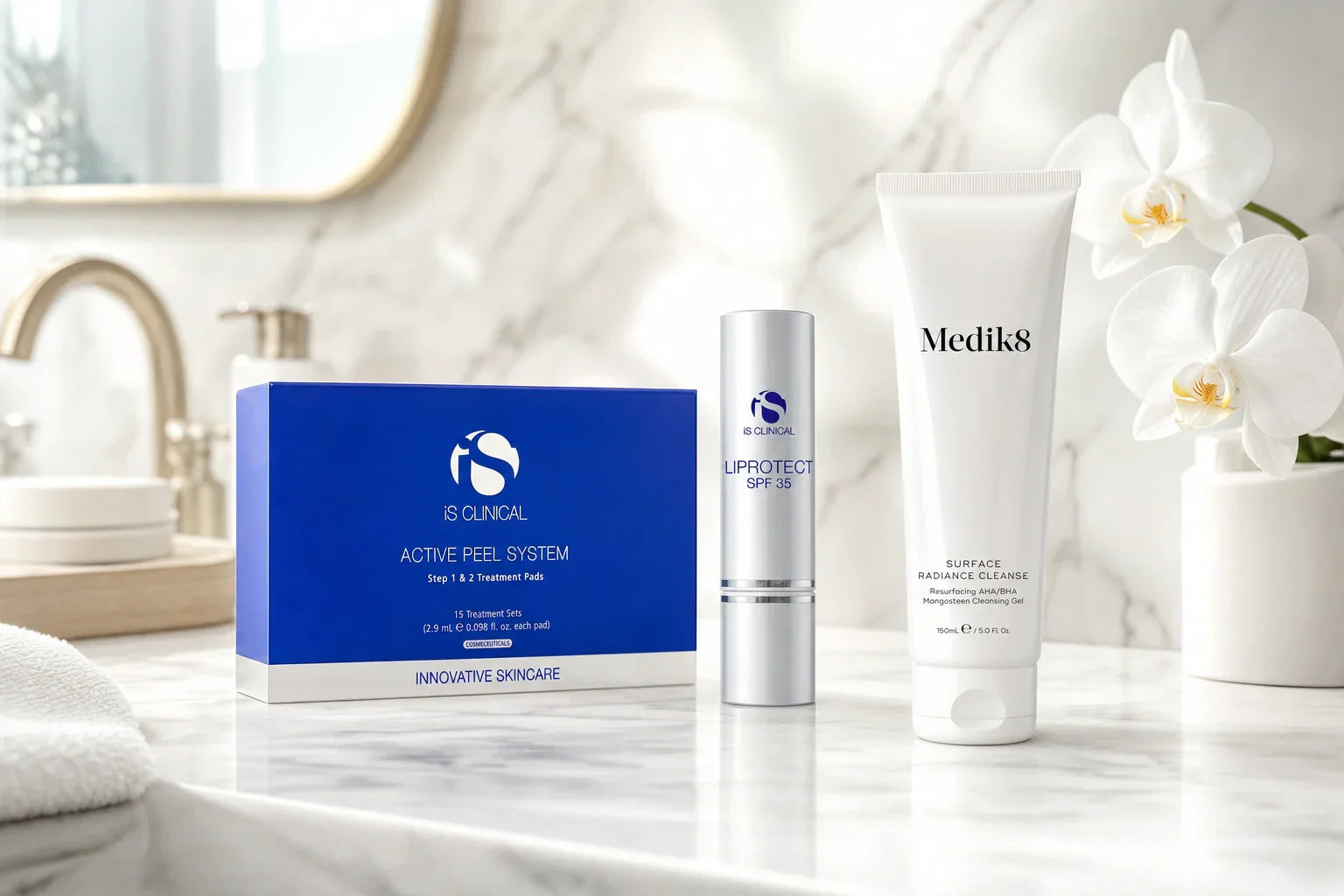
- Cleanse thoroughly — Use Surface Radiance Cleanse, a gentle AHA cleanser that preps skin without stripping. The glycolic acid content provides light pre-exfoliation, optimizing the peel's effect.
- Apply the peel — Active Peel System is a two-step treatment designed for every-other-day use. Step 1 resurfaces with a powerful blend of glycolic, lactic, and salicylic acids. Step 2 delivers hydration and antioxidant protection via a towelette saturated with soothing botanicals. Each step works synergistically to polish, hydrate, and protect — more than just surface exfoliation.
- Follow peel instructions — For the Active Peel System, apply Step 1, allow it to work for the recommended time, then follow with Step 2. No neutralization needed; the two-step sequence is designed to self-regulate.
- Hydrate — Follow with a lightweight, fragrance-free moisturizer. Avoid active serums (retinol, vitamin C) on peel nights — let the peel work alone.
- Morning after: SPF — The glycolic and salicylic acids in the Active Peel System increase photosensitivity. Apply LIProtect SPF 35 every morning to protect against UV-induced damage. This antioxidant-rich formula provides broad-spectrum protection while conditioning skin — ideal for post-peel care.
Photosensitivity note: Glycolic acid, lactic acid, and salicylic acid all increase sun sensitivity. Daily SPF 30+ is mandatory for at least 7–10 days post-peel. In Mediterranean climates, this is year-round practice.
On peel nights, skip retinol, vitamin C, and other actives. Your skin doesn't need multiple exfoliating mechanisms working simultaneously — that's a recipe for barrier compromise, not faster results.
FAQ
What does 'peel' mean in skincare?
In skincare, a peel is a chemical or enzymatic treatment that removes dead skin cells by breaking down the bonds holding them together. Unlike physical scrubs, peels work biochemically to accelerate your skin's natural shedding process, revealing smoother, brighter skin beneath.
Which peel works best for melasma?
Mandelic acid peels are often preferred for melasma because the larger molecule size reduces irritation risk compared to glycolic acid. However, melasma requires professional management — at-home peels alone won't resolve it. Combine with targeted serums, strict SPF, and professional treatments for visible improvement.
Can I use a peel every day?
No. At-home peels are formulated for 1–2× weekly use. Daily application would compromise your barrier, causing redness, flaking, and increased sensitivity. Professional-grade at-home peels like iS Clinical's Active Peel System are designed for every-other-day use at most — always follow product-specific instructions.
What's the difference between AHA and BHA peels?
AHAs (glycolic, lactic, mandelic) are water-soluble and work on the skin's surface — ideal for dryness, dullness, and photoaging. BHA (salicylic acid) is oil-soluble, penetrating into pores to address congestion and breakouts. Choose based on your primary concern: surface texture or pore clarity.
Chemical peels aren't about peeling visible skin — despite the name, most superficial peels won't leave you shedding like a sunburn. What they will do is support faster cell turnover, brighter tone, and smoother texture over consistent use. Start with 1× weekly, listen to your skin's response, and never skip SPF. For more on integrating exfoliants into your routine, see our guides on face peels for congested pores, masques and peels for stressed skin recovery, vitamin C for brightening, and our retinol routine for complementary active integration.